Originally appearing in The Source Weekly, an alternative weekly in Bend, Oregon, "What Remains" is my ode to old barns and decrepit downtowns.
The original story with illustrations may be found at:
www.tsweekly.com/index.php?option=com_content&task=view&id=2489&Itemid=2
Towns die for innumerable reasons. Whether changes in transit, the advent of the automobile, railroads or highways rerouted, or natural disasters, floods and fires. Chaos is another cause: Narrows, Oregon, was nearly eaten whole by jackrabbits until a bounty was placed on their ears; early Paisley never quite recovered from a failed payroll robbery that left one dead and the locals shaken. Swallowed by neighboring towns or cursed by events, others cede by choice, communal suicide, with residents agreeing to move on instead of further toil.
Maybe sadder are towns that don’t realize they’re dead, yet. Youth leaving for better opportunities elsewhere, generations erode until only old-timers sitting on sun-bleached porches remain. More abundant than ghost towns, dying towns receive few tourists; no one wants to view the terminal patient but the wake.
Central Oregon is an inhospitable landscape, making early migrant settlers some of the most stout in American memory. But the arid climate also preserves much of what they left behind – What Remains – on the high desert, hillsides and grasslands. Oregon is speckled with dozens of failed mining and/or forgotten towns, leaving us to wonder why a decrepit barn is so beautiful; have we learned from their mistakes?
Leaving Bend at pre-dawn before a mighty winter storm hits there are tumbleweeds blowing across Highway 97. How cliché – Going on a ghost town tour and Hollywood’s symbol of desolation is raking before our headlights. Our goal is to see such places not in spring or summer but winter, when settlers felt the full wrath of Central Oregon. A 100-mile northeastern swoop, weather permitting, we pass the silent Madras stock auction yards at first light.
Shaniko
This-ain't-tombstone...-The-shaniko-hotel-is-as-genuine-as-the-40-mph-winds.-Meanwhile,-a-portland-Doctor-has-bought-most-of-the-town.
Marked on maps as a “tourist ghost town” Shaniko is a shell of its former self, ravaged by fire and recently salvaged and partially preserved by a wealthy Portland doctor. Surrounded by windswept grasslands, the first signs that Shaniko is near are a placard for the 45th Parallel – the equidistant point between the North Pole and the equator – and fences for the R2 Ranch lining 97 north. Dr. Robert Pamplin, Jr., inheritor of a family denim manufacturing fortune, owns the R2 Ranch and the Portland Tribune newspaper. Self-described businessman, philanthropist, preservationist, farmer, minister and author, Dr. Pamplin started making investments in Shaniko a decade ago and now owns several of the town’s remaining buildings, most notably the wool barn.
Wool is what put Shaniko on the map. Established in 1900 with a population of 172 at the terminus of the Columbia Southern Railway, Shaniko became the center of the “Wool Capital of the World” (Central Oregon at least) with sales exceeding $3 million in 1903 and $5 million by 1905. Within a decade, however, Bend played a part in the demise of Shaniko, when the competing Oregon Trunk railroad was completed along the Deschutes River. Shaniko was the end of the line by 1911, and a fire that same year consumed most of the downtown. World War I opened inexpensive wool imports from Australia, and Shaniko was mostly silent by 1942. You will find no cemetery because the ground is too hard, which is fitting because Shaniko’s founders wouldn’t recognize the town today.
Reminiscent of Lago, the town Clint Eastwood exorcised in the movie High Plains Drifter, Shaniko has been revived as a tourist destination by Dr. Pamplin. False clapboard fronts and annual events (“Shaniko Days” are held every August) bring tourist dollars to town. One business owner who refused to be named estimated the population at 25, “except when the grandkids are visiting.” A decade ago his wife and sister were driving through, saw an old building needing fixing, so they stayed. Asked why people like to come to these towns, he groaned, “Beats the hell out of me.”
Me too, on a miserably chilly day with 40 mph winds and no other tourists in sight.
Yet this town’s former importance is obvious, and its structures impressive. And expensive – to maintain at least. When compared to pictures from Lambert Florin’s 1973 book Ghost Towns of the West, Shaniko gets more love than most. The Shaniko School was built in 1902 and its unusual octagonal steeple stands proud with a fresh coat of paint; the Shaniko Hotel is truly authentic while the Shaniko Wedding Chapel awaits an eloping couple.
Taking 218 towards Antelope it all became clear. Shaniko is in fact misnamed – it should have been Schernechau – and has been bought before. The tourist ghost town behind us actually brought the end to the once thriving stagecoach town before us.
Cross Hollows
A half-mile south of Shaniko stands two structures: A double-cupola barn and a single-room shack whose sole occupant is a rusty mattress. This is where Shaniko started, at the intersection of two gullies where people boarded stagecoaches to The Dalles and beyond. Cross Hollows was a prosperous community with a post office built by John and Elizabeth Ward, who were then bought out by German immigrant August Schernechau in 1874. The local Indians are said to have liked August but mispronounced his surname as “Shaniko.” With the departure of the postmaster in 1887, arrival of the railroad terminus and, ever essential, the discovery of water to the north, Cross Hollows was abandoned in favor of Shaniko.
Cross Hollows is an actual ghost town, population zero, exempting the dead badger someone slouched over a roadside stump. Other structures have crumbled, leaving only aged poplars as signs that more once stood here. Migrants often brought seeds to plant – lilacs and poplars – making circles of trees the sole evidence that this was once known as home.
Antelope
The dozen-mile stretch to Antelope on 218 is like Lombard Street in San Francisco: S-curves as it descends through Big Pine Hollow, along Sore Foot Creek, into the valley named in 1862 after the antelope that once grazed there. Here too is another town killed by Shaniko – Antelope had one of the earliest post offices in Central Oregon in 1871, supplying ranchers and writing regional religious and murderous history for well over a century. The sign outside town reads “Welcome to Historic Antelope, Pop. 37” but the 2000 census shows a population boom of 59 total residents (we saw only one).
Similar to Shaniko, the structures of Antelope are period and well maintained. The little church recalls the town’s early affluence, and recent upkeep, compared to photographs in Philip Varney’s 2005 book Ghost Towns of the Pacific Northwest. Meanwhile the decrepit jailhouse murmurs of murder. In 1885, Ed Gleason shot his business partner, Benjamin Pratt, dead, all due to rumors that Pratt had a crush on his wife. Gleason spent time in the jailhouse, and was later found justified of the killing.
A devastating fire in 1898 claimed most of the business district, and the establishment of Shaniko was fatal to Antelope. Still people were drawn here, including the founder of The Bend Bulletin, Max Luddemann, who married a local gal after building a chain of weekly newspapers, including the Madras Pioneer and the Ashwood Pioneer (based in another ghost town southeast of Antelope, of which little remains). Antelope's remoteness was only exacerbated when the state re-routed Hwy. 97 in 1917. But Antelope would be resurrected - rather divisively.
Bhagwan Shree Rajneesh arrived with thousands of devoted followers clad in red in 1981, and a cult-like commune was established outside Antelope. Their town soon renamed Rajneesh, Antelope looked more like Jonestown over the next four years, with charges ranging from food poisoning to embezzlement and immigration fraud. Rajneesh was ultimately deported. Facing an uncertain future, residents unincorporated the town and reverted to the original name of “Antelope” to avoid similar episodes. A plaque in town reads: “Dedicated to those of this community who throughout the Rajneesh invasion and occupation of 1981-1985 remained, resisted and remember...”
Curiously, Antelope’s future is again entrusted to a religious group; Rajneesh’s compound is now the Young Life church camp known as “Wild Horse Canyon.”
Onto Fossil
Route 218 passes padlocked grange halls and corporate ranches, revealing a political, commercial past and present. Crossing John Day River at Clarno offers optimism but barns stripped of sun-dried boards are all that eager eyes can see. Entering a fertile valley of crushed velvet green peaks and ancient fossils, seasonal recreational seekers seem the sole sign of life.
For $3 anyone may dig behind the Wheeler High School in Fossil. The only public fossil field in the United States, Fossil is selling itself. As it must: Established in 1876 as a post office and made the county seat of Wheeler County in 1899, Fossil is now drawing tourists with annual rodeos and a fledgling bluegrass festival. Locals only seem to smoke Marlboros and Kent menthols here: “We stock what people buy...” said the woman at the market. She’d just said a mouthful. Still supplied by the gravity water system installed in 1899, the 500 or so residents of Fossil seem resigned to remote relegation.
The weather has held out but dark clouds and winds are growing in the distance. To the east are other ghost towns, Lonerock and Hardman, but we must make our way back to Bend so we don’t find ourselves freezing overnight in structures proven deficient and abandoned long ago.
Richmond
School-anyone?--The-1874-Waldron-Schol-off-207-is-one-of-our-best-preserved-early-structures.
Like Antelope, Richmond was built to supply the surrounding ranchers in 1890. Located an eighth of a mile off route 207, equipped with a community center, school, church and several residences, Richmond sits in a serene valley that still invites. Yet the only visible resident was the loneliest black lab in the world. He followed us everywhere, attacking playfully, shooting mud with each assault and wag. There are newer homes, one a pseudo-rustic log cabin and another a redneck compound with a shotgun shack to the rear. Mercifully, only the dog welcomed us.
The church and school are both fenced, no trespassing allowed, perhaps because the pews of the church were removed and are now in the Fossil Museum; Richmond has suffered enough indignity. The community center is crumbling. A sampling of automobiles decomposes nearby. For such a splendid location – Iron Mountain in the distance – Richmond whispers a melancholy refrain. Century old echoes of a time when 450 people filled this little hamlet for the gathering of the Wheeler County Pioneers.
Now there’s only a lonely dog and posted structures. So we drove away like all the rest. The automobile undermined Richmond; young people refused to stay – the school that once taught 40 students closed in 1952 with one teacher for one student. Four miles south of Richmond on 207 is the 1874 Waldron School, easily the best-preserved structure so far on our journey, yet another school lacking students.
Mitchell and the Ochocos
207 to 26 and Mitchell: A town dying faster than Fossil. The 170 or so residents surely sense this, having suffered multiple floods (1904 and 1960) and fires (1896 and 1899) along Bridge Creek. Sometimes you must accept that you simply aren’t wanted.
A seasonal fishing and hunting town, Mitchell is for sale – A gray, frail building with a second-floor porch downtown is available for $69,000 “Price Reduced!” Leaving Mitchell, and only then seeing that town has crawled up the slope and wisely relocated at higher elevations to avoid flooding, we are heading for home, into the Ochocos and the face of the storm.
Our Remains
Oh, the Ochocos! Cabins and barns, in use or abandoned; route 26 is the only road to follow after eight hours and over two hundred miles of touring ghost towns. Wondering why we’re attracted to ghost towns, others’ failures, I now realize that we’ve missed the point.
They’re everywhere – Wherever we go, Americans especially, we leave messes. Buildings soon to be abandoned, we are conspicuous constructors: Our failed mines and forgotten structures are evidence of our itinerant earnestness.
Yet, only in ghost towns is this so vivid because of the void. Of people: At one time, in each of these empty places, it was admitted that all is lost. They left so now we return, to wander, to wonder. What if Cross Hollows had said no to Shaniko? Antelope become atheist? Richmond ignored the automobile and invited the Amish? Are Starbucks our new Grange Halls?
In this age of pre-assembled structures and planned obsolescence, what will remain? Are we as sturdy as those before? Or will we leave only ruins – piles of aluminum siding, sinkholes from septic tanks, toxic earth beneath engine blocks? Cracked concrete, our contribution, our legacy. What remains is who we are.
-30-
Sidebar:
“Who Shot Paulina?”
Image
The semi-permanent trailer that serves as the post office hardly inspires confidence in Antelope’s future, nor does it do justice to one of Central Oregon’s most famous figures – And killings.
By April of 1867, Howard Maupin was enraged by the persistent theft of livestock. So Maupin, who ran a stagecoach line, rode out with rancher James Clark to Trout Creek. Finding stolen cattle, they shoot at several Indians. One was wounded in the hip and didn’t return fire. Accounts vary on whose shot found the mark, Maupin’s or Clark’s; neither knew the significance at the time. Still they scalped the indian and left the body where it lay. Unbeknownst to Maupin or Clark they had killed Chief Paulina. Howard Maupin would get the credit and was later named postmaster of Antelope. Streets and a town named in his honor memorialized the deed. Meanwhile, lakes, valleys and peaks throughout Central Oregon eulogize Chief Paulina.
Saturday, August 16, 2008


Living Art: On the street with Bend's best unsung artist
An ode to my good friend Francisco Christich, this was the most personal piece I've ever been assigned. He's talented, intelligent, and forced to clean bathrooms of a bar...
For the original illustrated story visit:
www.tsweekly.com/index.php?option=com_content&task=view&id=3112&Itemid=2
We met at the Westside Tavern last December, a stool between us and Ferris Bueller’s Day Off on the TV. Pointing to the screen he sighed, “The downturn of society...” I, however, considered John Travolta a sign of the Apocalypse, underscored by his contribution to Hairspray. Two beers and all of Francisco’s money later, now seated side by side, we both agreed that the tipping point of America was Ronald Reagan.
Francisco Christich: the name of a friar or cult leader. Or an artist, nine-ball guru, father and friend. Francisco, the most modest human being I met in my nine months in Central Oregon. A song; the antidote to gloating galleries and braggart collectors, trust-fund artist managers – We both knew we’d spend much time together after that night at the Westside. Yet neither could have guessed how rotten it would end.
His entry to Bend was apt. It was a choice between here or Sante Fe; “When the car broke down that kind of made the solution clear.” That was 30 years ago. Francisco will be 62 in September and shows every second on this Earth. A scar under his gray hay hair from a car crash 20 years since (of windshields he offers, “They’re hard – they win, you lose.”), ashy marks like cuffs around his wrists (“Some pigmentosis...” he explains, then jokes, “Actually I got those storming the cliffs of Normandy.”) and a silky white beard Santa would wear if evicted from the North Pole. An American mutt, Francisco’s father was Mexican and Slavic while his mother was Native American and French, “As far as I know.” Raised in East LA, it was his mother who sat him down at an easel when he was four and told him to paint.
Fifteen hundred works later, Francisco Christich is a famously unknown artist. Some of his paintings hang on private walls (mine included, bearing his sublime “Cosmic Junkyard”), 500 are in storage while the other 1,000 “just slipped away.” Of the three total murals in Taos, New Mexico, he painted two. In Bend his works are scattered across town, the most recent being outside the Wall Street Bar – three panels depicting a ghost town along Smith Rock, Klondike Kate, and a tall two-section piece showing the flow of the Deschutes. The images are striking, more so because Francisco hardly had any paint, “Green, blue, had to steal some red – It was fun, challenging to use exactly what I had.”
He’s being charitable today. The last time I saw Francisco he wasn’t so merry, rather bitter. A room for rent has made all the difference. Francisco’s been homeless for the past few months, hopping between couches and empty buildings. “You can only stay in a place so long, you gotta keep moving...” Nearly arrested on the westside for squatting weeks ago, he overheard a conversation between the building’s owner and leaser and knew then the jig was up. Onto another place, this is nothing new; “I lived on the street in the ‘90s.”
To know Francisco, look into his eyes. Talk to him. Buy him a beer for the effort; honor. The miracle of this man is his undeniable aura, however dire the situation or dour his spirit. For an artist to watch the rise of Bend as an artistic city, and to be ignored throughout, he has every right to feel slighted. But it runs deeper, and why Francisco deserves recognition – Because he seeks none. Instead of jealousy or angst he takes a long-view, ever the outsider, “I saw in the local arts magazine all the people at Art Walk smiling, drinking wine. That looks like fun.”
Francisco doesn’t do shows. He had one in Tacoma and describes it as “a lesson in futility.” He’s shy at first then affable and gregarious after proving you’re a “real human being” – I had a ping pong party in January and, of the nearly 20 contestants, Francisco was the only one who didn’t play. But he was the one person everyone remembered, with some offering him a room if he’s ever in Portland.
I was renting Val and Tyler Winterholler’s home in Tumalo at the time. Val’s an artist too, a painter with a sense for scratching a seemingly finished piece to reveal its true soul. Inexplicably she started painting pods nearly two years ago, until realizing she was pregnant with a daughter, Tessa – a subliminal if not eerie signal. Alas, their house was soon for sale so I moved an alley away, into an overpriced shack with bad vibes. I couldn’t create, winter wouldn’t go away, and I wasn’t the only one struggling.
Francisco had lost his studio apartment in the Broadway Courts, unable to afford $450 a month, and his landlords refusing to take art in lieu of rent. “Nice people, sorry I lost it.” Back to hopping couches, again, and his constitution worsening – wheezing and tearing, allergic to the dog in the house. It’s hard to bitch when bumming a bed, but Francisco obviously needed help. So I took him in, offering a spare bedroom with visions of an artistic commune: Me writing, him painting, quitting late afternoon to molt minds.
Gentle, passive, introspective, Francisco is a flower child with caveats. Speaking of his generation he gets sentimental, “We’ve been through peaks and valleys, and now we’re in a valley... The Sixties were quite energetic, dynamic, the age of assassinations, LSD. There are two hippie generations, one on TV and the other real. I think that story’s never been told, the revolution. We bought a bag of goods, a picture of a picture of a picture.”
It’s such introspection and modesty – Francisco’s inability and/or unwillingness to go out and sell himself – that has limited his success, as he readily admits, “I’m always open to offers but offers are few and far between... If you don’t compete it’s a little tougher.”
Instead of competing and promoting, Francisco creates. He paints, incessantly, two or three projects at a time. Early inspirations being Gauguin, Cezanne, Dali, Picasso (“The beginning of the end of art – The traditionalists hated those guys”) now his art emerges from his mind, “I suppose dreams, and Native America, to keep it alive.”
Francisco slowly recovered but was ever sensitive to my smoke (cigarette at least), buying us groceries with his food stamps, seeking inspiration. It lasted hardly three weeks. That house is cursed and I simply had to leave, find another spot. Our farewell was in the form of a yell, “See ya, Francisco!” mopping the floors of our failed commune as he pushed his bike with a busted front rim away.
I found a house with a dog to sit but he wasn’t so lucky. That’s when Francisco became homeless, again, mostly my fault but the misguided guilt trip that ensued was equally shared. We saw each other but seldom spoke. For a time I considered contacting his son Eli, a writer and graphic artist in Portland, or daughter Hesper Moon, the mother of Francisco’s two grandchildren, and asking them to come and fetch their father. He was in bad shape, mentally and physically. But I know Francisco; his character refutes aid – Even when totally broke I never saw him beg. Subtle nods and blank stares became our greetings and goodbyes. Both bitter, our brief moment of bliss ending so badly, I set to writing as Francisco sought a spot to sleep that night.
Exacerbating the silent tension was the lack of any response from my literary agent. I’d set myself up, see, and dragged Francisco along, dreams and dreads included. “A Strange September Song” is the novel Francisco wrote years ago in a single month. “Like a gift dictated to me. 99.5% the way it was,” is the way he describes the story, the process. About a reckoning between pool hustlers, “A Strange September Song” is based on Francisco’s past life as a nine-ball player.
Not a hustler or shark, rather an itinerant pro since graduating Palo Alto High School in 1964, Francisco’s fame-claim is beating the #9 player in the world when he took Billy Johnson for $35 in San Diego. His “biggest score” was here, pocketing $3,500 total in Bend in the early 1980s, playing $700 a game. And then there’s that Boise bar full of farmers betting. He entered and decided, “It’s not a good idea to hustle a farmer. So I announced myself...” Later, each farmer shook his hand as Francisco left with $500 in winnings. The circuit can be unkind, though, hustlers wear out their welcome quickly: A good friend of Francisco’s, Jesse James (his actual name), took a girlfriend down south, through Oklahoma, “and he never made it out.” Only the girlfriend returned, and wouldn’t speak of what happened to Jesse James.
Francisco doesn’t play much pool anymore. He wins when he does, but fading eyesight and lackluster local competition make it a tedious task. Having been around the best for decades he says of Bend, “It’s like watching Tiger Woods, then going and playing miniature golf.”
“A Strange September Song” is a damn good read if you ask me. But my agent wouldn’t know – I sent her the first few chapters and there’s been no response, yet. This irked Francisco, more so when on the street with no address to receive even a rejection letter. It irked me too, but for other reasons. I had a novel of my own to finish and at last living in a fertile house – If my agent can’t be bothered to read a novel from a friend, will she bother to sell mine? This is when Francisco gets prickly, bringing up the topic of his novel and my agent’s unresponsiveness – Blunt as it may be, I couldn’t be bothered; I’d given Francisco a place to stay, however briefly, and now I had bigger worries.
The bitterness only grew. Especially when I told Francisco I was house- and dog-sitting for Midda and David Kinker on Delaware. Midda is a gem, the nurse I’ll need someday soon, while David is an artist. And competition for Francisco, a fellow muralist, despite the fact he refuses to compete. David is his opposite. A working artist, well-known and in demand, not shy to offer his services for pay, trade (receiving enough coffee for an Army from Strictly Organic to paint an ivy pergola above the self-service area) and at times gratis at public events – “Balloons Over Bend” and the Country Fair.
However inverse, when asked which local artists he respects, Francisco affords, “There’s a lady in Sisters, and I like most of David Kinker’s work.”
And then there’s the new breed, the “corporate muralists” – those who offer to do work for “free” while including product- and logo-placement in pieces. “Undermining the art world,” groans Francisco, “One comes by and offers to do it for free, while a working artist should be charging $20,000.”
Having lived with three artists by now – Val Winterholler, Francisco, and now David Kinker – I’d seen the full spectrum of arts in Bend. But not Francisco for a time, weeks without a glimpse; only by visiting the Wall Street Bar at dawn is that assured.
For money Francisco cleans the Wall Street every morning, his latest mural on the wall outside as he mops and readies the lavatories for another ruckus. “It’s amazing the amount of shit that’s left at the Wall Street – I found a joker’s hat last week, and a used extra large [maxi-pad] lying on the floor... That was nice. It’s amazing what people will do under the influence of alcohol. The nicest people too, absolutely Jekyll and Hyde, but also lots of Hydes and Hydes, it just makes it worse.”
Our final meeting meant closure for both of us. I was on a plane the next week back to New York and he’d just found a room to rent. The bitterness had faded, helped by his new home and several beers. And our conversation, the interview for this article requested by the publisher of The Source (the most consistent patron of Francisco’s work over the years), offered us an excuse to reunite. Never enemies – even as our relationship became strained under the weight of expectation and disappointment – perhaps it’s our shared experience that makes us true friends. Since first meeting at the Westside last December and agreeing that Reagan was the “downturn of society,” living and failing together, then meeting again in mid-July, it’s good to be with an old friend.
To see Francisco smile... To hear him mention “A Matter of Urgency” – his next book which, despite its title, “will take me 35 years to write. It’s a commitment to write and I become obsessive about projects.”
To be graced by his aura: artist, author, nine-ball guru, father and friend.
Survivor: “I have a love-hate relationship with Bend. There is a thriving culture in Bend. Socially it seems only bars; we sold the nightlife but they’ll get out of it. Businesses coming and going. Cookie cutter restaurants in a kit.”
Take a swig my dear friend.
“Buddhists say life is suffering. But it is grand. The universe is a trip, this endless sky.”
Smile.
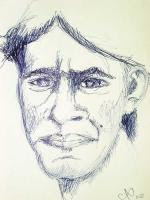
He sketched me after the interview. Made me appear leaner, more serious, better than I ever could be. So we shook hands and parted ways, no more words needed.
For the original illustrated story visit:
www.tsweekly.com/index.php?option=com_content&task=view&id=3112&Itemid=2
We met at the Westside Tavern last December, a stool between us and Ferris Bueller’s Day Off on the TV. Pointing to the screen he sighed, “The downturn of society...” I, however, considered John Travolta a sign of the Apocalypse, underscored by his contribution to Hairspray. Two beers and all of Francisco’s money later, now seated side by side, we both agreed that the tipping point of America was Ronald Reagan.
Francisco Christich: the name of a friar or cult leader. Or an artist, nine-ball guru, father and friend. Francisco, the most modest human being I met in my nine months in Central Oregon. A song; the antidote to gloating galleries and braggart collectors, trust-fund artist managers – We both knew we’d spend much time together after that night at the Westside. Yet neither could have guessed how rotten it would end.
His entry to Bend was apt. It was a choice between here or Sante Fe; “When the car broke down that kind of made the solution clear.” That was 30 years ago. Francisco will be 62 in September and shows every second on this Earth. A scar under his gray hay hair from a car crash 20 years since (of windshields he offers, “They’re hard – they win, you lose.”), ashy marks like cuffs around his wrists (“Some pigmentosis...” he explains, then jokes, “Actually I got those storming the cliffs of Normandy.”) and a silky white beard Santa would wear if evicted from the North Pole. An American mutt, Francisco’s father was Mexican and Slavic while his mother was Native American and French, “As far as I know.” Raised in East LA, it was his mother who sat him down at an easel when he was four and told him to paint.
Fifteen hundred works later, Francisco Christich is a famously unknown artist. Some of his paintings hang on private walls (mine included, bearing his sublime “Cosmic Junkyard”), 500 are in storage while the other 1,000 “just slipped away.” Of the three total murals in Taos, New Mexico, he painted two. In Bend his works are scattered across town, the most recent being outside the Wall Street Bar – three panels depicting a ghost town along Smith Rock, Klondike Kate, and a tall two-section piece showing the flow of the Deschutes. The images are striking, more so because Francisco hardly had any paint, “Green, blue, had to steal some red – It was fun, challenging to use exactly what I had.”
He’s being charitable today. The last time I saw Francisco he wasn’t so merry, rather bitter. A room for rent has made all the difference. Francisco’s been homeless for the past few months, hopping between couches and empty buildings. “You can only stay in a place so long, you gotta keep moving...” Nearly arrested on the westside for squatting weeks ago, he overheard a conversation between the building’s owner and leaser and knew then the jig was up. Onto another place, this is nothing new; “I lived on the street in the ‘90s.”
To know Francisco, look into his eyes. Talk to him. Buy him a beer for the effort; honor. The miracle of this man is his undeniable aura, however dire the situation or dour his spirit. For an artist to watch the rise of Bend as an artistic city, and to be ignored throughout, he has every right to feel slighted. But it runs deeper, and why Francisco deserves recognition – Because he seeks none. Instead of jealousy or angst he takes a long-view, ever the outsider, “I saw in the local arts magazine all the people at Art Walk smiling, drinking wine. That looks like fun.”
Francisco doesn’t do shows. He had one in Tacoma and describes it as “a lesson in futility.” He’s shy at first then affable and gregarious after proving you’re a “real human being” – I had a ping pong party in January and, of the nearly 20 contestants, Francisco was the only one who didn’t play. But he was the one person everyone remembered, with some offering him a room if he’s ever in Portland.
I was renting Val and Tyler Winterholler’s home in Tumalo at the time. Val’s an artist too, a painter with a sense for scratching a seemingly finished piece to reveal its true soul. Inexplicably she started painting pods nearly two years ago, until realizing she was pregnant with a daughter, Tessa – a subliminal if not eerie signal. Alas, their house was soon for sale so I moved an alley away, into an overpriced shack with bad vibes. I couldn’t create, winter wouldn’t go away, and I wasn’t the only one struggling.
Francisco had lost his studio apartment in the Broadway Courts, unable to afford $450 a month, and his landlords refusing to take art in lieu of rent. “Nice people, sorry I lost it.” Back to hopping couches, again, and his constitution worsening – wheezing and tearing, allergic to the dog in the house. It’s hard to bitch when bumming a bed, but Francisco obviously needed help. So I took him in, offering a spare bedroom with visions of an artistic commune: Me writing, him painting, quitting late afternoon to molt minds.
Gentle, passive, introspective, Francisco is a flower child with caveats. Speaking of his generation he gets sentimental, “We’ve been through peaks and valleys, and now we’re in a valley... The Sixties were quite energetic, dynamic, the age of assassinations, LSD. There are two hippie generations, one on TV and the other real. I think that story’s never been told, the revolution. We bought a bag of goods, a picture of a picture of a picture.”
It’s such introspection and modesty – Francisco’s inability and/or unwillingness to go out and sell himself – that has limited his success, as he readily admits, “I’m always open to offers but offers are few and far between... If you don’t compete it’s a little tougher.”
Instead of competing and promoting, Francisco creates. He paints, incessantly, two or three projects at a time. Early inspirations being Gauguin, Cezanne, Dali, Picasso (“The beginning of the end of art – The traditionalists hated those guys”) now his art emerges from his mind, “I suppose dreams, and Native America, to keep it alive.”
Francisco slowly recovered but was ever sensitive to my smoke (cigarette at least), buying us groceries with his food stamps, seeking inspiration. It lasted hardly three weeks. That house is cursed and I simply had to leave, find another spot. Our farewell was in the form of a yell, “See ya, Francisco!” mopping the floors of our failed commune as he pushed his bike with a busted front rim away.
I found a house with a dog to sit but he wasn’t so lucky. That’s when Francisco became homeless, again, mostly my fault but the misguided guilt trip that ensued was equally shared. We saw each other but seldom spoke. For a time I considered contacting his son Eli, a writer and graphic artist in Portland, or daughter Hesper Moon, the mother of Francisco’s two grandchildren, and asking them to come and fetch their father. He was in bad shape, mentally and physically. But I know Francisco; his character refutes aid – Even when totally broke I never saw him beg. Subtle nods and blank stares became our greetings and goodbyes. Both bitter, our brief moment of bliss ending so badly, I set to writing as Francisco sought a spot to sleep that night.
Exacerbating the silent tension was the lack of any response from my literary agent. I’d set myself up, see, and dragged Francisco along, dreams and dreads included. “A Strange September Song” is the novel Francisco wrote years ago in a single month. “Like a gift dictated to me. 99.5% the way it was,” is the way he describes the story, the process. About a reckoning between pool hustlers, “A Strange September Song” is based on Francisco’s past life as a nine-ball player.
Not a hustler or shark, rather an itinerant pro since graduating Palo Alto High School in 1964, Francisco’s fame-claim is beating the #9 player in the world when he took Billy Johnson for $35 in San Diego. His “biggest score” was here, pocketing $3,500 total in Bend in the early 1980s, playing $700 a game. And then there’s that Boise bar full of farmers betting. He entered and decided, “It’s not a good idea to hustle a farmer. So I announced myself...” Later, each farmer shook his hand as Francisco left with $500 in winnings. The circuit can be unkind, though, hustlers wear out their welcome quickly: A good friend of Francisco’s, Jesse James (his actual name), took a girlfriend down south, through Oklahoma, “and he never made it out.” Only the girlfriend returned, and wouldn’t speak of what happened to Jesse James.
Francisco doesn’t play much pool anymore. He wins when he does, but fading eyesight and lackluster local competition make it a tedious task. Having been around the best for decades he says of Bend, “It’s like watching Tiger Woods, then going and playing miniature golf.”
“A Strange September Song” is a damn good read if you ask me. But my agent wouldn’t know – I sent her the first few chapters and there’s been no response, yet. This irked Francisco, more so when on the street with no address to receive even a rejection letter. It irked me too, but for other reasons. I had a novel of my own to finish and at last living in a fertile house – If my agent can’t be bothered to read a novel from a friend, will she bother to sell mine? This is when Francisco gets prickly, bringing up the topic of his novel and my agent’s unresponsiveness – Blunt as it may be, I couldn’t be bothered; I’d given Francisco a place to stay, however briefly, and now I had bigger worries.
The bitterness only grew. Especially when I told Francisco I was house- and dog-sitting for Midda and David Kinker on Delaware. Midda is a gem, the nurse I’ll need someday soon, while David is an artist. And competition for Francisco, a fellow muralist, despite the fact he refuses to compete. David is his opposite. A working artist, well-known and in demand, not shy to offer his services for pay, trade (receiving enough coffee for an Army from Strictly Organic to paint an ivy pergola above the self-service area) and at times gratis at public events – “Balloons Over Bend” and the Country Fair.
However inverse, when asked which local artists he respects, Francisco affords, “There’s a lady in Sisters, and I like most of David Kinker’s work.”
And then there’s the new breed, the “corporate muralists” – those who offer to do work for “free” while including product- and logo-placement in pieces. “Undermining the art world,” groans Francisco, “One comes by and offers to do it for free, while a working artist should be charging $20,000.”
Having lived with three artists by now – Val Winterholler, Francisco, and now David Kinker – I’d seen the full spectrum of arts in Bend. But not Francisco for a time, weeks without a glimpse; only by visiting the Wall Street Bar at dawn is that assured.
For money Francisco cleans the Wall Street every morning, his latest mural on the wall outside as he mops and readies the lavatories for another ruckus. “It’s amazing the amount of shit that’s left at the Wall Street – I found a joker’s hat last week, and a used extra large [maxi-pad] lying on the floor... That was nice. It’s amazing what people will do under the influence of alcohol. The nicest people too, absolutely Jekyll and Hyde, but also lots of Hydes and Hydes, it just makes it worse.”
Our final meeting meant closure for both of us. I was on a plane the next week back to New York and he’d just found a room to rent. The bitterness had faded, helped by his new home and several beers. And our conversation, the interview for this article requested by the publisher of The Source (the most consistent patron of Francisco’s work over the years), offered us an excuse to reunite. Never enemies – even as our relationship became strained under the weight of expectation and disappointment – perhaps it’s our shared experience that makes us true friends. Since first meeting at the Westside last December and agreeing that Reagan was the “downturn of society,” living and failing together, then meeting again in mid-July, it’s good to be with an old friend.
To see Francisco smile... To hear him mention “A Matter of Urgency” – his next book which, despite its title, “will take me 35 years to write. It’s a commitment to write and I become obsessive about projects.”
To be graced by his aura: artist, author, nine-ball guru, father and friend.
Survivor: “I have a love-hate relationship with Bend. There is a thriving culture in Bend. Socially it seems only bars; we sold the nightlife but they’ll get out of it. Businesses coming and going. Cookie cutter restaurants in a kit.”
Take a swig my dear friend.
“Buddhists say life is suffering. But it is grand. The universe is a trip, this endless sky.”
Smile.
He sketched me after the interview. Made me appear leaner, more serious, better than I ever could be. So we shook hands and parted ways, no more words needed.
Subscribe to:
Posts (Atom)